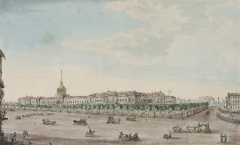
The Admiralty. 250th anniversary of Adrian Zakharov's birth
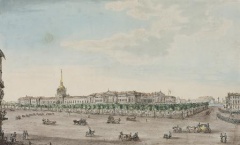 from 8 November 2011 to 29 February 2012
To mark the anniversary of Adrian Zakharov's birth (1761–1811), this exhibition presents the items, connected with the main architect's project – the construction of the group of the Admiralty buildings in St Petersburg.
The exhibition at Peter and Paul Fortress is based on the collections of the State Museum of the History of St Petersburg and the Central Naval Museum. Some 300 items introduce the visitors to the history of the Admiralty, one of the most famous attractions of St Petersburg.
The Admiralty was started by Peter the Great on 16 November 1704 as a fortified shipyard, and had soon become a major shipbuilding centre in Russia. It was surrounded by a rampart and a moat, constructed in 1705, and had two bastions facing the Neva River. The buildings of the Admiralty have been redesigned for several times. In 1711, Harmen van Boles designed a spire with the weather vane in the shape of a ship to be added to the central gate of the Admiralty. In 1730, the architect Ivan Korobov replaced the wooden structure with a stone building. Between 1806 and 1823 the structures of the Admiralty were completely redesigned by the architect Adrian Zakharov in the Neoclassical style. Today the Admiralty ranks among the most beautiful architectural ensembles of St Petersburg. Its golden spire with the weather vane “little ship” that sits atop remains one of St Petersburg's most recognizable landmarks. Three of St Petersburg’s main streets– Nevsky and Voznesensky Prospects, Gorokhovaya Ulitsa – radiate out from a point in front of the main gate of the Admiralty building like a giant trident belonging to Neptune.
In 1844 the construction of ships at the Admiralty ceased, all canals and docks being filled in. In the second half of the nineteenth century works to construct the Admiralty Embankment began. A beautiful façade of the Admiralty that faced the Neva was hidden by various multi-storey houses, and the city of St Petersburg had lost one of its spectacular views.
The exhibition in Peter and Paul Fortress presents items, connected with the history of the Admiralty as the largest eighteenth century shipyard in Russia. It showcases architectural designs of the Admiralty by Ivan Korobov and Adrian Zakharov, and original fragments of the decoration of the stern section of the Poltava battleship (1709–1712) and a model of a Zakhary and Elisavet gunboat (1745–1748) (both ships were built at the Admiralty). Among the most interesting exhibits are a wooden model of the 1766 St Petersburg Admiralty and the original gilded Admiralty weather vane, made in 1846. Plaster models, made in the 1980–2000s after the engravings by Adrian Zakharov, recreate the statues, destroyed in the middle of the nineteenth century (allegorical representations of Europe, Asia, Africa, America; largest Russian rivers; months).
Paintings of the eighteenth – nineteenth centuries, photographs of the late nineteenth – early twentieth centuries enable the visitors to trace how the appearance of the Admiralty and the adjacent city area was changing throughout the centuries. The exhibition includes series of photographs showing the Admiralty building during the siege of Leningrad in 1941–1944.
The Admiralty building has become one of the main symbols of St Petersburg. It is commonly depicted on paintings and drawings, and its image can be found on various souvenirs. The exhibition presents the collection of the objects, showing the Admiralty: porcelain dishes, mug and saucer sets of the early nineteenth century, production of the Leningrad Porcelain Factory (present Imperial Porcelain Factory), stationery, postcards, badges, stamps, match labels, soap, perfume and cosmetics packaging.